
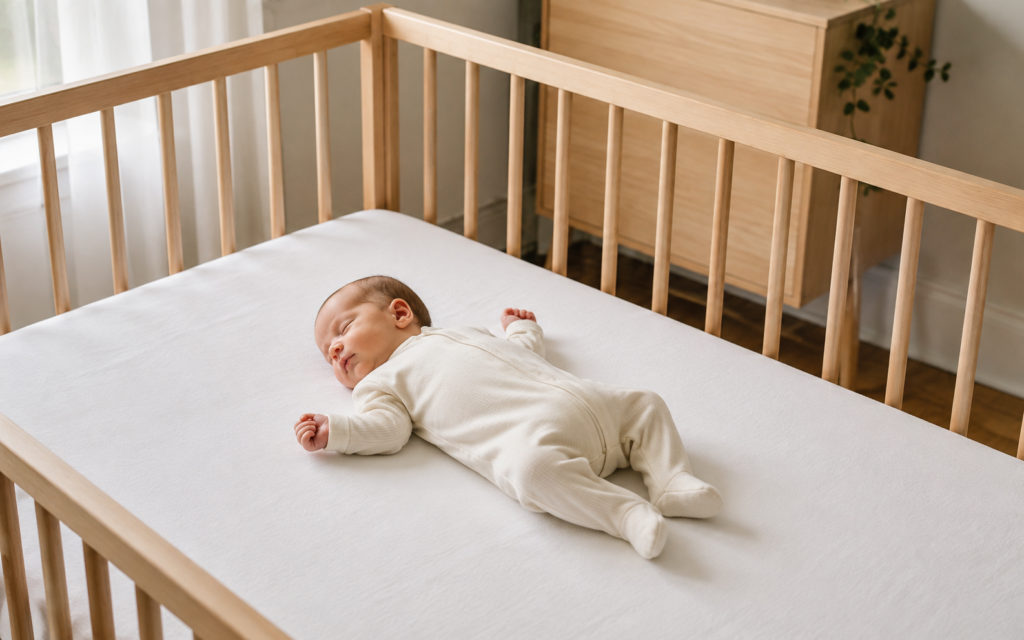
A newborn can sleep for much of the day and still leave their parents wondering whether anyone in the house is getting enough sleep.
Short naps, frequent night waking, falling asleep during a feed and waking again soon afterwards are all common in the first months. Newborn sleep looks very different from adult sleep, and one of the most helpful things for new parents is simply knowing what is normal.
There is no perfect newborn sleep schedule. Babies develop their own patterns, and these patterns can change quickly as they grow.
How much should a newborn sleep?
The World Health Organization recommends 14–17 hours of good-quality sleep within a 24-hour period for babies aged 0–3 months, including naps.[1] Some babies naturally sleep somewhat more or less, and the amount and timing of sleep can vary considerably between babies.
Importantly, those hours are not normally one long stretch of sleep.
A newborn may sleep for a couple of hours, wake to feed and be changed, spend a short time awake and then fall asleep again. At other times, a nap may be surprisingly short. This pattern can continue around the clock.
For parents accustomed to sleeping for seven or eight uninterrupted hours, this can feel chaotic. For a newborn, however, frequent waking is expected.
Why does my newborn wake so often at night?
One of the main reasons is simple: newborn babies need to feed regularly.
They also have not yet developed the same clear distinction between day and night that older children and adults have. During the first weeks, a baby may be just as ready to wake at 2 a.m. as at 2 p.m.
NHS guidance notes that newborn babies repeatedly wake during the night during the first months and that their individual sleep patterns can differ greatly.[2]
Frequent waking therefore does not automatically mean that your baby is a “bad sleeper” or that you have created the wrong habits.
It is also worth being cautious about comparisons. One friend’s six-week-old may sleep for a long stretch at night while another baby of exactly the same age wakes much more often. Both can be within the range of normal development.
Helping your baby learn the difference between day and night
Although a newborn cannot be expected to follow a strict schedule, you can gently help them begin to recognise the difference between daytime and night-time.
During the day, let natural light into the home and continue with normal household activity. There is no need to make the entire house silent whenever the baby sleeps.
At night, keep things calmer. Lower the lights, speak quietly and make feeds and nappy changes as peaceful and unstimulating as possible.
This simple contrast is also recommended by the NHS as a way of gradually helping a baby understand that night is different from day.[2]
A bedtime routine can begin early, but it does not need to be complicated. A feed, a clean nappy, sleep clothes, dimmed lights and a few quiet minutes together can be enough.
At this age, consistency is more useful than a rigid timetable.
Safe sleep matters more than a perfect sleep routine
During the first months, parents often spend a great deal of energy thinking about how long their baby sleeps. An even more important question is how safely they sleep.
Current safe-sleep guidance from the NHS, CDC and American Academy of Pediatrics is consistent on several fundamental points.[3][4][5]
For every sleep, including daytime naps:
- place your baby on their back;
- use a firm, flat sleep surface;
- keep pillows, soft toys, cot bumpers and other soft objects out of the baby’s sleep area;
- avoid loose bedding around the baby’s face;
- take care that the baby does not become too hot.
The safest place for a baby during the first six months is a separate cot, crib or Moses basket in the same room as the parent or caregiver.[3][4][5]
A sofa or armchair is not a safe place to fall asleep with a baby. Soft or inclined sleep surfaces should also be avoided.
How warm should the room be?
It is natural to worry about a tiny baby becoming cold, but overheating should also be avoided.
NHS guidance uses 16–20°C as the standard room-temperature range for a 2.5 tog baby sleeping bag and recommends adjusting the baby’s clothing and sleeping bag according to room temperature.[3]
Do not judge your baby’s temperature from their hands or feet alone, as these can feel cooler than the rest of the body. If your baby’s chest feels hot or they are sweating, they may be too warm.
The sleep area itself should remain clear rather than adding pillows or extra soft bedding for warmth.
What if my baby only wants to sleep close to me?
Newborn babies naturally seek closeness. They recognise familiar voices, warmth, movement and touch.
It is therefore very common for a baby to settle easily while being held or fed and then wake when circumstances change.
This does not mean that you have “spoilt” your newborn.
The important distinction is between comforting a baby while you are awake and creating a safe environment when you or the baby may fall asleep.
If you are becoming sleepy yourself, place the baby back in their own safe sleep space. NHS and AAP guidance both advise that a separate cot or crib in the parents’ room is safer than sharing an adult sleep surface.[3][5]
Should I put my newborn on a sleep schedule?
For most newborns, a strict by-the-clock sleep schedule is neither necessary nor realistic.
Instead, start by observing your baby.
Signs of tiredness can include yawning, becoming quieter, looking away, fussiness or losing interest in interaction. Over time, you will begin to recognise your own baby’s patterns.
The pattern may still change from week to week.
A baby who has several relatively predictable days may suddenly begin waking more frequently again. Growth, feeding needs and normal development can all affect sleep.
Rather than trying to create a perfect schedule immediately, focus on a calm routine, safe sleep and responding to your baby’s needs.
When does sleep become more predictable?
There is no single age at which every baby begins sleeping for longer stretches.
As babies grow, many gradually begin to sleep for longer periods at night and spend more time awake during the day. NHS guidance notes that between approximately three and six months some babies may sleep for five to eight hours or longer at night, while others will not.[2]
That last part is important.
Sleep development is not a competition.
The fact that another baby of the same age is sleeping longer does not necessarily mean there is anything wrong with yours.
When can a baby monitor be useful?
During the earliest weeks, many parents naturally keep their newborn nearby most of the time. As family routines develop, however, a baby monitor can become useful.
Perhaps your baby is sleeping in the bedroom while you prepare dinner. Maybe you are working in another room during a daytime nap, or you simply want to hear when the baby wakes without repeatedly opening the bedroom door.
An audio baby monitor can help in these situations.
The Britton BC-50Li baby monitor, available in Speli’s current baby range, is a digital audio monitor with features including adjustable microphone sensitivity, room-temperature display on the parent unit, an out-of-range alert, vibration mode and a talk-back function. Both the parent and baby units can operate using rechargeable batteries or mains power.[6]
A baby monitor should be considered an additional everyday convenience rather than a replacement for safe-sleep practices. Your baby’s sleeping environment should follow the same safety recommendations whether or not a monitor is being used.
When should sleepiness worry you?
Newborns sleep a lot, so it can sometimes be difficult to know when sleepiness is simply normal and when a baby may be unwell.
Seek prompt medical advice if your newborn is unusually difficult to wake, cannot be woken normally, is feeding poorly, has difficulty breathing or seems significantly different from their usual behaviour.
A temperature of 38°C or higher in a baby under three months of age requires urgent medical assessment.[7]
When it comes to a young baby, it is always reasonable to contact a healthcare professional if you are concerned.
What new parents should remember
The first months are not about achieving perfect sleep.
Newborn sleep is naturally fragmented and unpredictable. Your baby may sleep well one night and wake repeatedly the next. A routine that seems to work this week may look completely different a few weeks later.
Instead of concentrating on whether your newborn is already “sleeping through the night”, focus on the things that matter most:
Is my baby sleeping safely? Are they feeding normally? Do they seem well when awake?
Longer stretches of sleep and a more predictable day-and-night rhythm usually develop gradually.
Until then, frequent waking is often not a problem to fix.
It is simply part of life with a newborn.
Sources
[1] World Health Organization (WHO).
Guidelines on physical activity, sedentary behaviour and sleep for children under 5 years
Sleep recommendations for infants aged 0–3 months.
[2] NHS.
Helping your baby to sleep
Newborn sleep patterns, night waking and helping babies distinguish between day and night.
[3] NHS – Best Start in Life.
Safe sleep advice for babies
Guidance on back sleeping, sleep surfaces, room sharing, bedding and temperature.
[4] Centers for Disease Control and Prevention (CDC).
Helping Babies Sleep Safely
Safe-sleep recommendations including back sleeping, firm flat sleep surfaces and keeping soft objects out of the sleep area.
[5] American Academy of Pediatrics – HealthyChildren.org.
How to Keep Your Sleeping Baby Safe: AAP Policy Explained
AAP recommendations on safe infant sleep and room sharing.
[6] Britton.
Baby Monitor Britton BC-50Li
Manufacturer’s product information and specifications.
[7] NHS.
When to get urgent medical help for babies and children under 5
Warning signs requiring urgent medical attention, including fever in babies under three months.
This article provides general information for parents and caregivers and is not a substitute for individual medical advice. If you are concerned about your baby’s health, contact a qualified healthcare professional.
 English
  Eesti
Eesti